A 39-year old male smoker with hypertension, suddenly develops severe left sided chest pain with extension to left arm, sweating, respiratory distress and syncopal attack. What is your probable diagnosis?
Author Archives: Thiriveni Balajji G S
Answer to case history 1 2020 batch
Most probable diagnosis is Myocardial infarction
Case history 1 2020 batch
A 48- year old male is complaining of sudden onset of severe retrosternal chest pain, diaphoresis and respiratory distress. On examination, he had rapid and feeble pulse with cold extremities.
What is the most possible diagnosis?
Opthalmology Anatomy and physiology MCQs
1. Stromal layer of cornea develops from
A. Surface ectoderm
B. Neural ectoderm
C. Mesoderm
D. Endoderm
2. All the following ocular structures are derivatives of mesoderm EXCEPT
A. Crystalline lens
B. Primary vitreous
C. Corneal endothelium
D. Extraocular muscles
3. All the following are true with regard to newborn eye EXCEPT
A. Hypermetropic by +2 to +3 D
B. Eyeball less divergent
C. Shallow anterior chamber
D. Myelination of optic nerve fibers has reached the lamina cribrosa
4. All the following are true regarding eye at birth EXCEPT
A. Pupil does not dilate fully
B. Lens is spherical
C. Tears are not secreted
D. Wide angle of anterior chamber
5. In a new born 6/6 visual acuity is attained at the age of
A. 6 months
B. 1 year
C. 2 years
D. 6 years
6. All the following parts of eye develop from surface ectoderm EXCEPT
A. Epithelium of Conjunctiva
B. Epithelium of Iris
C. Epithelium of cornea
D. Lacrimal glands
7. Crystalline lens develops from
A. Surface ectoderm
B. Neural ectoderm
C. Mesoderm
D. Endoderm
8. Normally — ml of aqueous humor is present in the anterior chamber
A. 2.5
B. 0.6
C. 0.25
D. 0.06
Answer to clinical case 5 Barrett’s Oesophagus

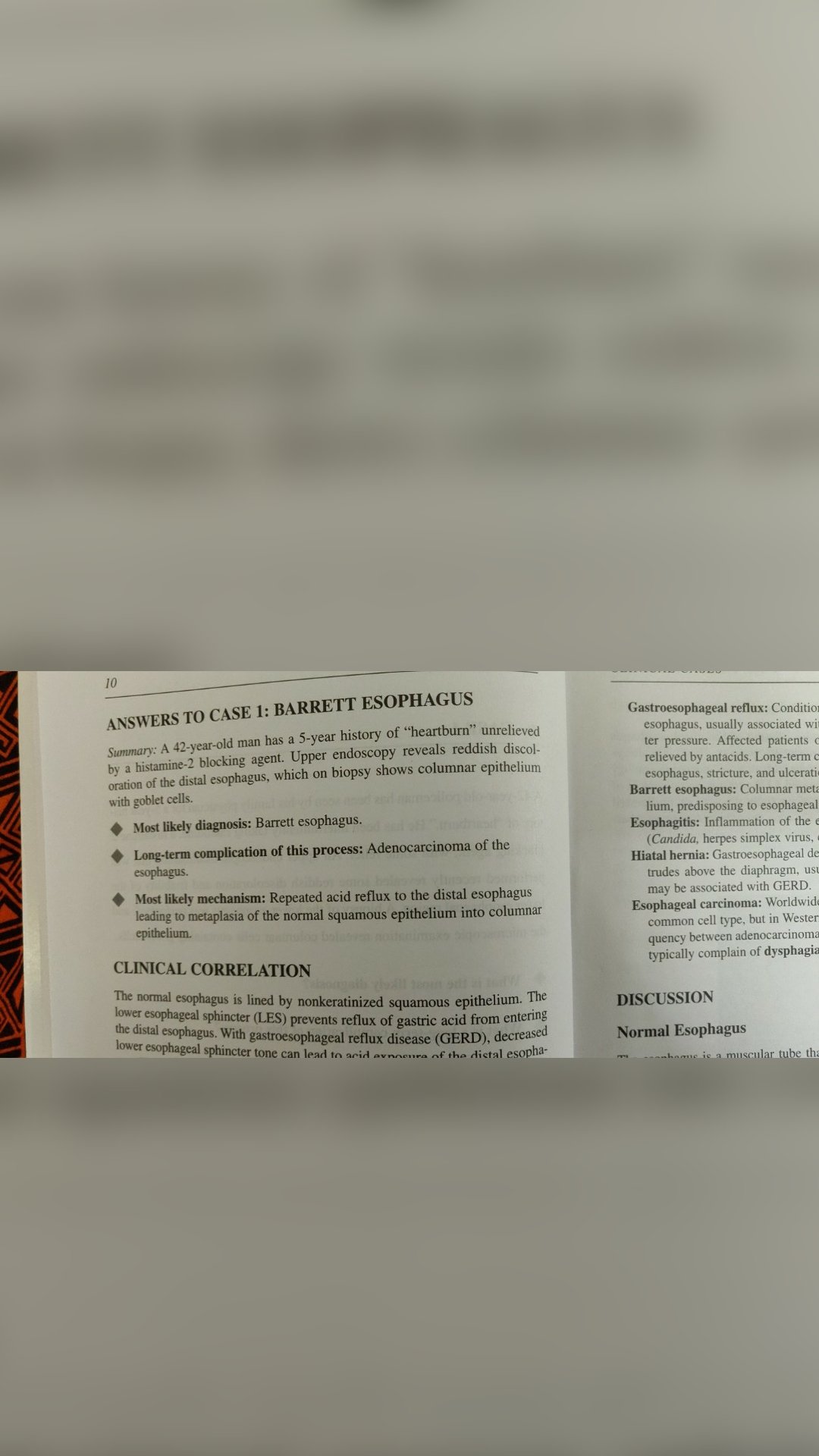
Clinical case 5

Answer for Clinical case 4
Since he complains of right lower quadrant pain and fever, with no history of trauma. He also has nausea and vomiting. Hence the diagnosis is Acute appendicitis
Clinical case 4
A 25 years old man returns home after playing cricket, and starts complaining of pain in the mid-abdomen without history of any injury. The pain remains unremitting for the next few hours; instead it becomes more severe and gets localised to the lower right quadrant. He also develops nausea and vomiting but no diarrhea. Over the next 24 hours, he remains sick and keeps rolling in bed with severe pain and is brought to the hospital emergency.
On examination, his body temperature is 102 degree Fahrenheit and appears ill. His abdomen is mildly distended and diffusely tender on palpation, especially in the right lower quadrant.
Discuss the clinical correlation with pathogenesis of the features
What is the probable diagnosis?
How will you investigate and confirm the diagnosis?
Reference for clinical case 3 Harrison 18th edition of 2439
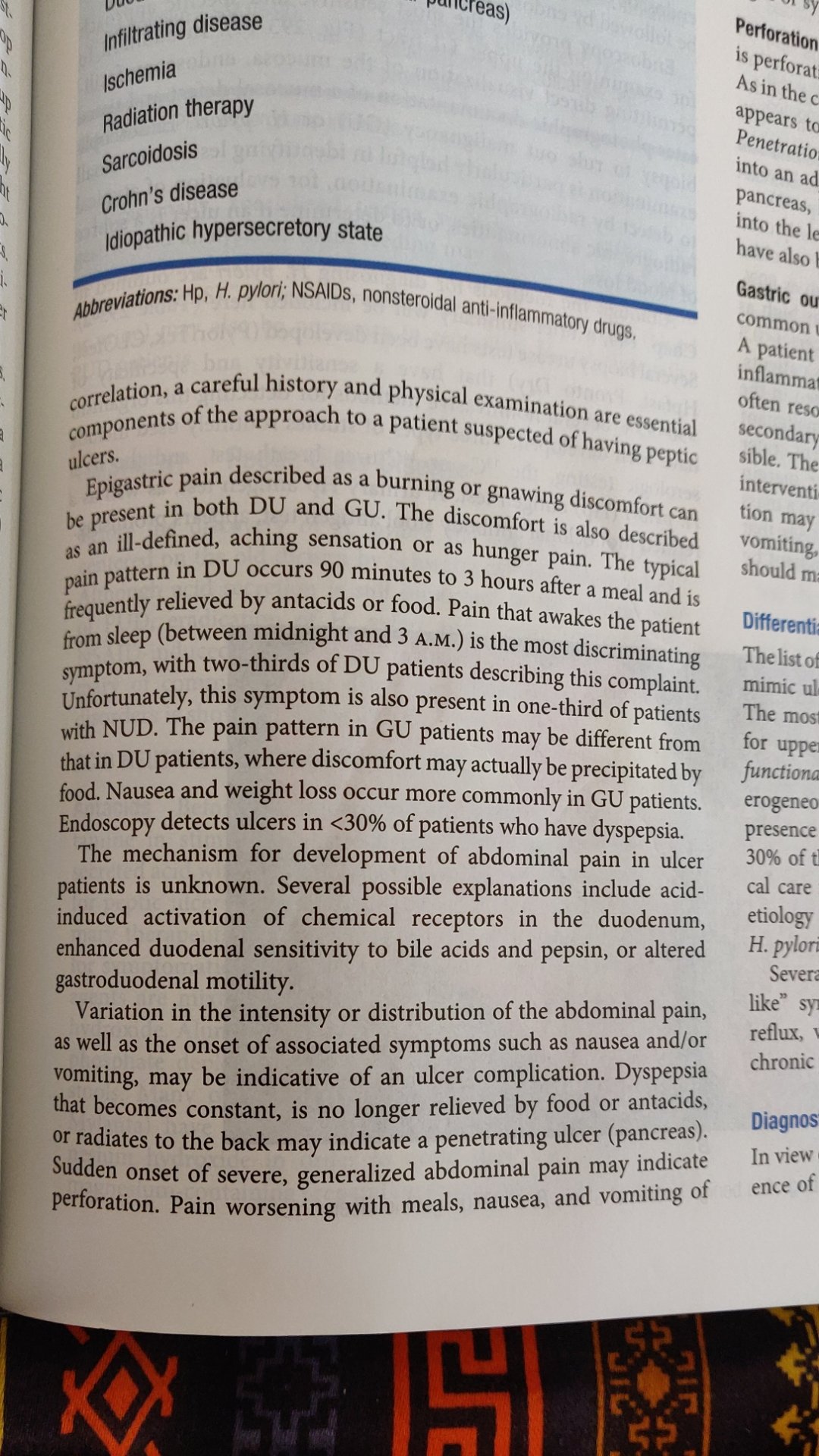
Answer for Clinical case 3
35 year old male with epigastric pain, relieved by food. Night hunger pain present. Nsaid intake history present. So, diagnosis is Peptic Ulcer Disease, Duodenal ulcer
 virtualPath